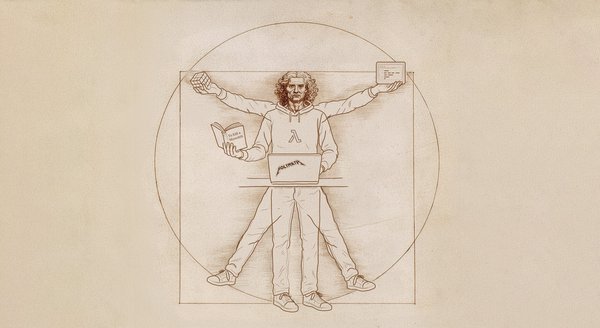
Tools change, but the fundamentals endure. As generative AI reshapes how we build software, a familiar trope has re-emerged, the narrative that developers will become obsolete. But if history has taught us anything, this is not the end of the developer, it’s the dawn of something new, the renaissance developer.
You’ve heard the rumblings. Read the headlines telling us that AI will make developers obsolete. That anyone can code now. Just describe what you want to do, and tools will take care of the rest. That the era of the professional developer is over.
We’ve seen and heard this before. Early assembly programmers were told that compilers would make them redundant. Instead, compilers elevated the level of abstraction and opened software development to far more people. What once required deep hardware expertise became an act of logic and creativity. Entire industries emerged because software became something many could build. Businesses, research labs, and universities suddenly had the ability to create their own tools.
In the 2000s, operations engineers expressed similar concerns when cloud computing arrived. They feared automation would make them obsolete. Instead, it lowered barriers to experimentation and created an explosion of new projects, new companies, and new engineering roles. Every simplification produced greater demand.
Each technological leap forward has followed a similar pattern. Tools evolve, workflows change, and complexity increases, yet the core attributes of great developers remain constant. Creativity, curiosity, and systems thinking have continued to define the craft.
Time and time again we have seen that lowering the barrier for entry doesn’t eliminate the need for human expertise, it amplifies it. Generative AI lets us generate code in seconds, but if you put garbage in, you get really convincing garbage out. The AI doesn’t sit in budget meetings where leadership debates whether to optimize for cost or performance. It doesn’t understand that the customer service system needs five 9s of uptime while the internal reporting dashboard can go down during peak sales periods. It can’t read between the lines when a stakeholder says, “make it fast” but might mean “make it cheap.” The politics, the constraints, the unspoken priorities that shape every technical decision are nuanced and require a developer who understands why it matters to the humans who pay for it and the humans that will use it.
Before Leonardo DaVinci painted the Mona Lisa, he dissected cadavers to understand muscle structure, studied water flow to design canal systems, and observed birds to imagine flying machines. His Vitruvian Man was more than art—it was a diagram of proportions and a philosophical statement about humanity’s place in the world. Like the Renaissance greats who combined art, science, and engineering, the developers who thrive in this AI-augmented world must become modern polymaths – renaissance developers.
They understand that systems are living, dynamic environments where changes ripple through services, APIs, databases, infrastructure, and people. They communicate with clarity that both humans and machines can build from. They own the quality, safety, and intent of what they create, especially as AI grows more confident in its errors. They bring domain knowledge that AI cannot replicate, such as understanding the business, the customer, and the real-world constraints that matter. They never stop learning.
The fundamentals that have always made great developers remain unchanged. But like the great thinkers of the Renaissance who refused to be confined to a single discipline, developers can no longer live in silos. You must think bigger, the moment demands it. This is the dawn of a new age for developers. You have never been more valuable. Your creativity has never been needed more. So keep building, stay curious, and keep solving the world’s hardest problems.
Read my full predictions for 2026 and beyond on All Things Distributed.